

The members of the Order of Friars Minor, founded by St Francis in 1209, arrived in Transylvania via Germany and Hungary between 1240 and 1250, settling first in Banská Bystrica, Sibiu and Târgu Mures (Târgu Mures). The first Franciscan monks arrived in Esztergom in 1677. In the upper part of Esztelnek there was already a chapel of St. George, with a wooden monastery built next to it. This monastery was blessed on 1 October 1690. The church next to the monastery was built between 1710 and 1729 using elements of the old St George's Chapel - probably the sanctuary of the church. The stone monastery was built in...

The church probably acquired its present late Gothic form in 1547, when it was rebuilt at the expense of Patron Paul Daczo. The church was damaged several times by a series of earthquakes. Originally, the church was surrounded by two walls - a ring of fortifications - and had two towers. The outer wall was demolished by the parish in 1786 and these stones were used to build, by order of Joseph II, a building for the German school, which stands next to the bell tower and is now used as a cantorial lacquer. In the cinerarium of the castle church, we can find the graves of several prominent personalities associated with the name of Sfântu Gheorghe...

The Unitarian church fortress in Nagyajta is the oldest architectural and art-historical building complex in the municipality. The church fortress, surrounded by a 5 m high wall and protected by two bastions, was built at the highest point of the settlement, on the hill called „Crow's Nest”, in the second half of the 16th century or the beginning of the 17th century, according to documents. In the inner courtyard of the fortress stands a late 14th century Gothic church with a nave vault. Its most valuable elements are the chalice-shaped pulpit, composed of four cassettes carved in stone, and the balustrade, also carved in stone, dating from 1710. In terms of antiquity, it is considered the sixth oldest pulpit in Transylvania...

The church, built in the 13th century, preserves several architectural styles: Romanesque, Gothic, Renaissance and Baroque. The wall frescoes depicting the legend of St. Lazarus from the 14th and 15th centuries, and the scenes of his battle against the Huns, are among the best preserved in Transylvania. Among the oldest and most valuable elements of the church are the centuries-old baptismal font and the uniquely painted coffered ceiling, consisting of 103 pieces, some of which date from 1629.
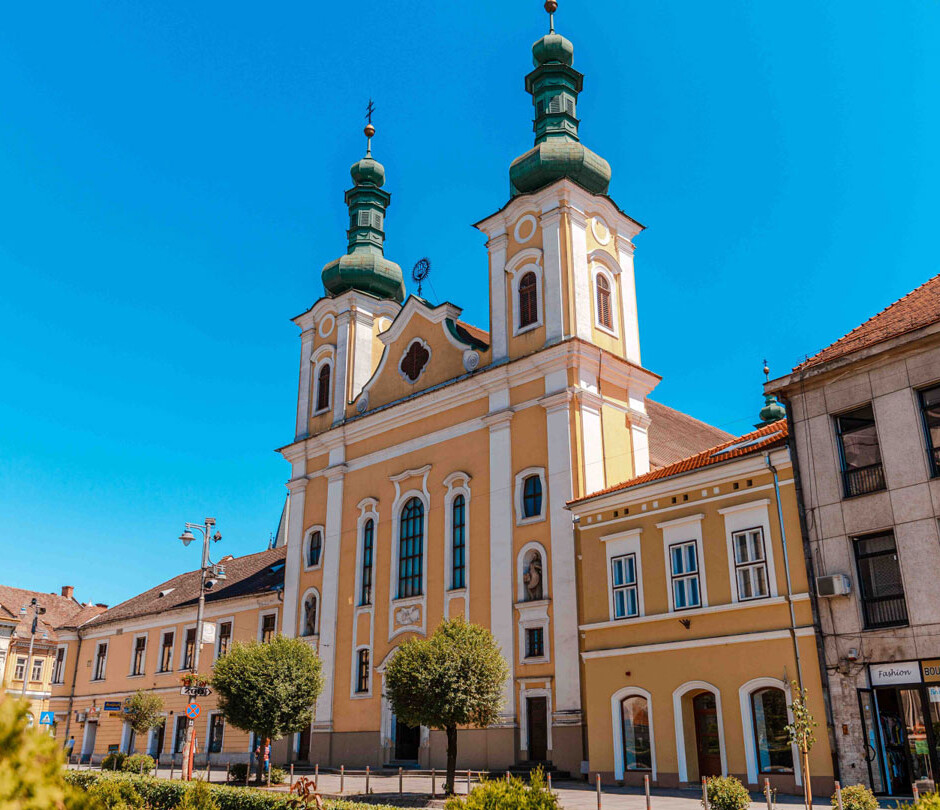
The Parish of St John the Baptist, more commonly known as the Church of Friends, is one of the oldest and most important Roman Catholic churches in Târgu Mures. Located in the centre of the city, in the main square, the church is associated with the Franciscan Order and has played a significant role in Catholic life for centuries. The church dates back to the 18th century, when the Franciscan monks built a new Baroque church on the site of an earlier medieval church. The Order has played a significant role in the religious life of Târgu Mures in order to preserve the Catholic religion. The church was built between 1741 and 1750, mainly...

The Reformed Church of Dálnok is one of the most significant ecclesiastical and architectural monuments in Transylvania, serving the local Reformed community since the Reformation. It is located in the village of Dálnok and has a unique historical value, having played a significant role in the religious life of the village for centuries. The exact date of the church's construction is unknown, but its foundations date back to the Middle Ages. In the 16th century, with the spread of the Reformation, the local congregation joined the Reformed faith and the building was adapted accordingly. Over the centuries, it has been extended and renovated several times, while trying to preserve the...

The monumental ensemble in the Udvarhely region is a UNESCO World Heritage Site. It was built in the 15th century and its ramparts date back to the 17th century. Its greatest value lies in the 15th-century wall paintings inside, of which the most significant is undoubtedly the one depicting the legend of St. Lazarus, painted in 1419 on the order of István Ungi's son, one of the best preserved paintings of St. Lazarus. The inner side of the castle wall was once surrounded by an assassin's gallery, which was dismantled in 1788 when it was no longer needed for defence. An interesting feature of the fortress wall is that the inside was built with colours, where the villagers...