For thousands of years people have set out on journeys because of their faith: to pray, to give thanks, to fulfil a vow, or simply to come closer to what they hold sacred. Religious tourism is one of the oldest forms of travel – and Székely Land, where four historic churches live side by side, is an especially rich setting for it.
What is religious tourism?
Religious tourism covers journeys whose main purpose, or an important part of which, is a religious site, event or tradition. The boundaries are not sharp: tourism research describes the pilgrim and the tourist as the two ends of a scale, and most travellers are somewhere in between. A devout pilgrim also admires the Baroque altar, while a cultural traveller may be moved by the silence of a Mass.
Read more: What is religious tourism?
Two thousand years of pilgrimage
Pilgrimage is as old as religion itself. The timeline shows the key milestones from the perspective of Christian Europe and the Carpathian Basin – all the way to Székely Land.
- Antiquity
Sanctuaries and pilgrimage feasts
The ancient Greeks travelled from distant lands to the oracle of Delphi and the sanctuaries of Olympia. Jewish tradition called the faithful to the Temple in Jerusalem for three great pilgrimage feasts – Passover, Shavuot and Sukkot.
- 4th century
Jerusalem and the beginnings of Christian pilgrimage
After Christianity could be freely practised under Emperor Constantine the Great, the Church of the Holy Sepulchre was built in Jerusalem and consecrated in 335. Egeria, a pilgrim woman from the West, travelled the Holy Land between 381 and 384; her account is one of the earliest surviving pilgrim narratives.
- 9th–12th century
Santiago de Compostela
In the early 9th century the tomb of St James the Apostle was believed to have been found in Galicia, and Compostela became one of the most important pilgrimage destinations of medieval Europe. The 12th-century Codex Calixtinus even contained a guide for pilgrims.
- around 1018
St Stephen opens the overland route
King St Stephen gave safe passage and help to pilgrims crossing Hungary, so the overland route through the Carpathian Basin became one of the main roads to the Holy Land. According to the chronicle of Rodulfus Glaber, an immense crowd of nobles and commoners set out for Jerusalem this way.
- 1300
The first Holy Year in Rome
Pope Boniface VIII proclaimed the first Jubilee Year in 1300, which drew crowds to Rome. Since then, Holy Years have been the high points of pilgrimage to Rome.
- 1442–1448
Csíksomlyó: church, friary, pilgrimage
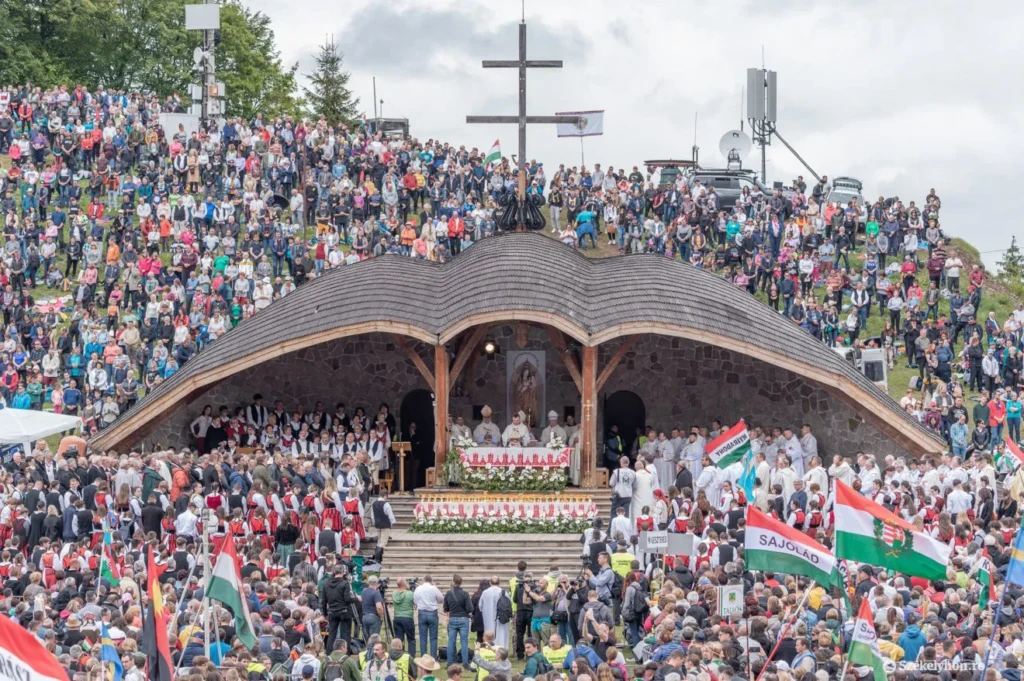
With the support of John Hunyadi, the Franciscan church and friary of Csíksomlyó were built, and in 1444 Pope Eugene IV granted the church an indulgence. Tradition links the Whitsun pilgrimage to the events of 1567; historians regard this as a legend, but the pilgrimage itself has been a living practice for centuries.
- 1568
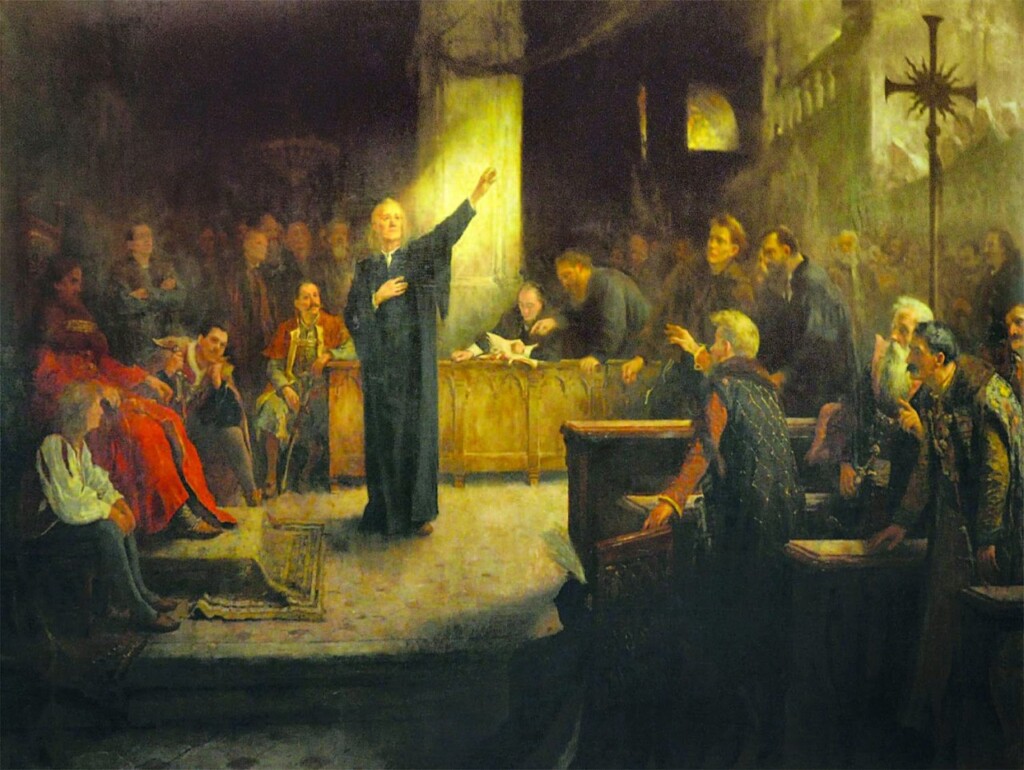
Religious freedom at Torda
In January 1568 the Transylvanian Diet at Torda proclaimed freedom of preaching and of faith – among the first in the world. As a result, four received religions took shape in Transylvania: Catholic, Reformed, Lutheran and Unitarian. This diversity still defines the church map of Székely Land today.
- 1950–1989
Decades of prohibition
From 1950 the communist authorities effectively banned the traditional pilgrimage to Csíksomlyó: outdoor processions were forbidden and pilgrims were kept under surveillance. The faithful still came, and from the late 1960s again in their thousands.
- 1987
Europe rediscovers its pilgrim routes
In 1987 the Council of Europe launched its Cultural Routes programme with the Santiago de Compostela Declaration. The old routes came back to life: in 2025 more than 530,000 pilgrims received the Compostela certificate.
- from 1990
Free once again
After the fall of communism the Csíksomlyó pilgrimage could once again be held freely, and since then hundreds of thousands have come every Whitsun. Mary’s Way was also born: a network of pilgrim paths some 1,400 kilometres long linking Mariazell with Csíksomlyó.
- 2019–2020
A papal Mass and Hungaricum status
Pope Francis celebrated Mass at Csíksomlyó on 1 June 2019. In 2020 the Whitsun pilgrimage of Csíksomlyó was added to the collection of Hungarikums.
Highlighted points relate to the Carpathian Basin and Székely Land.
The Hungarian pilgrimage tradition
The Hungarian word búcsú originally meant an indulgence: the grace the faithful could obtain by making a pilgrimage on a church’s feast day. This is the origin of its present meaning: the feast of a church’s patron saint, to which pilgrims come from far and wide.
Pilgrims often walk for several days in parish groups, carrying a cross and banners, singing and praying. The great Marian shrines of the Carpathian Basin – Máriapócs, Mátraverebély-Szentkút, Máriaradna, Csíksomlyó and, across the border, Mariazell – have been centres of the Hungarian Catholic tradition for centuries. The Protestant churches, too, have their own places of remembrance and feasts.
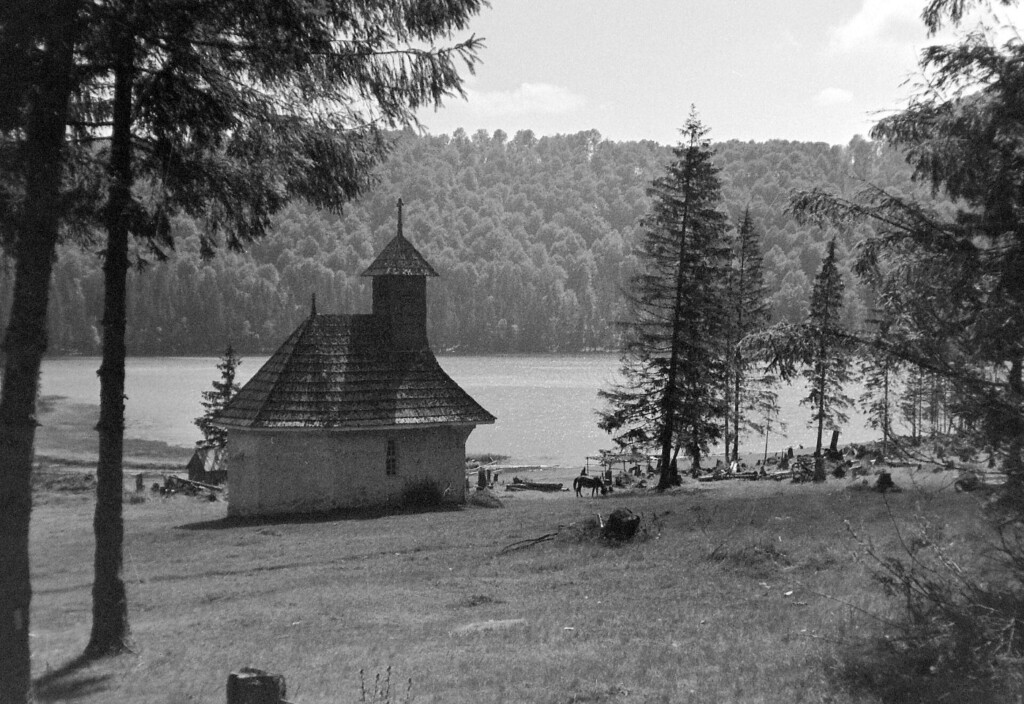
In Székely Land, besides the Whitsun pilgrimage of Csíksomlyó, the July feast of the chapel on the shore of St Anne’s Lake, the patronal feasts of the pilgrimage churches and the Corpus Christi processions are the largest community gatherings.
Székely Land: four denominations, one landscape
In Székely Land, Catholic, Reformed and Unitarian villages lie within a few kilometres of one another, and the Armenian merchants who settled here in the 17th century built their own Catholic churches. This diversity goes back to the path of the Reformation in Transylvania and to the religious freedom proclaimed at Torda.
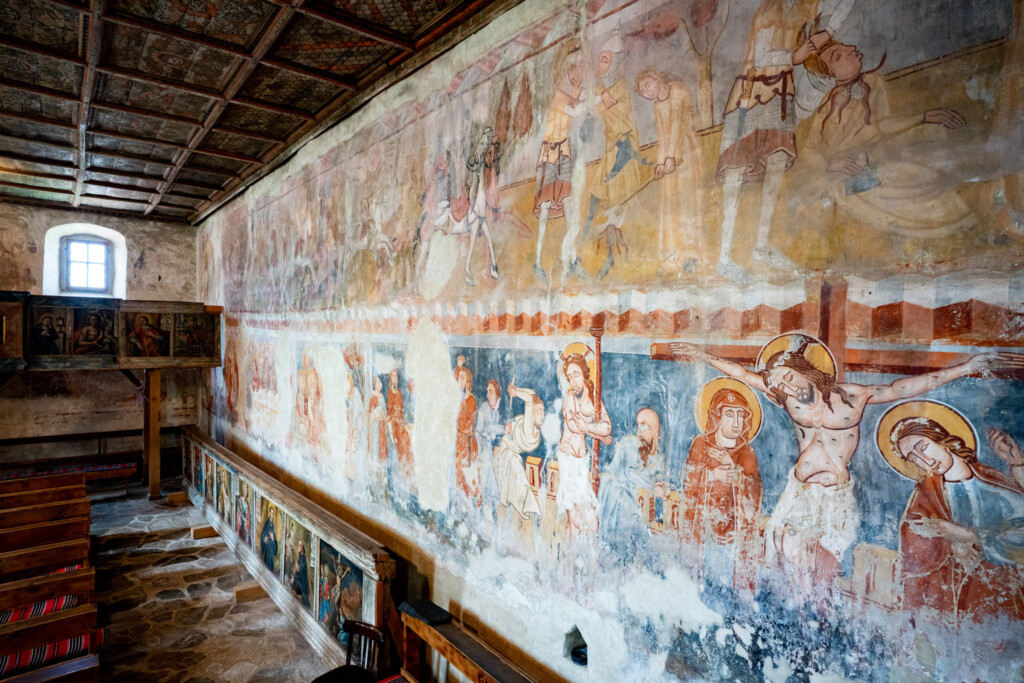
During the Ottoman and Tatar raids, village churches were surrounded with stone walls and bastions: this is how the fortified churches came about, where the villagers themselves took refuge in times of danger. The same story often recurs on medieval church walls: the legend of St Ladislaus, the knight-king’s duel with the Cuman warrior who abducted a girl. In the 17th and 18th centuries painted coffered ceilings adorned church interiors – with flowers, stars and sometimes inscriptions in Old Hungarian runic script.
The friaries also played a special role: the Franciscans of Csíksomlyó, Mikháza, Gyergyószárhegy and Esztelnek kept the Catholic faith alive in the area through the centuries of the Reformation, running schools and libraries – and, at Csíksomlyó, a printing press.
Religious tourism today
According to UN Tourism estimates, there are some 600 million domestic and international religious trips in the world every year. Today’s pilgrim often seeks silence, community, movement and heritage all at once: walking and cycling pilgrim routes, slow multi-day journeys and the discovery of smaller, lesser-known shrines are all popular.
Digital tools help too: route planning with maps, an online pilgrim passport and an audio guide read aloud by your own device – all of these are available on Peregrinus.
How to visit a shrine
- In church, wear clothing that covers shoulders and knees; men should remove their hats.
- Do not walk around or take photos during Mass or a service – if a service is under way, wait until it ends.
- Many village churches are kept locked: it is worth arranging your visit with the parish office a day or two in advance.
- Traffic is heavy on pilgrimage days – set off early and, if possible, arrive by public transport or on foot.
- You can support the upkeep of the church with a donation; in many places they will gladly stamp or sign your pilgrim passport.
More on Peregrinus
Sources
- UN Tourism: Tourism can protect and promote religious heritage (2014)
- Council of Europe: Cultural Routes of the Council of Europe programme
- Pilgrimaps: Camino de Santiago – a new peak in pilgrim numbers
- Magyarságkutató Intézet: Királyok és szentek
- Magyar Posta: The Diet of Torda was held 450 years ago (2018)
- Transtelex: Két világháború, tiltások és újrakezdések – a 20. századi Csíksomlyó (2026)
- Infostart: A csíksomlyói búcsú bekerült a hungarikumok gyűjteményébe (2020)
- Mária Út: sajtóanyag (2019)