St Martin's Parish Church – Mattersburg (Nagymarton)
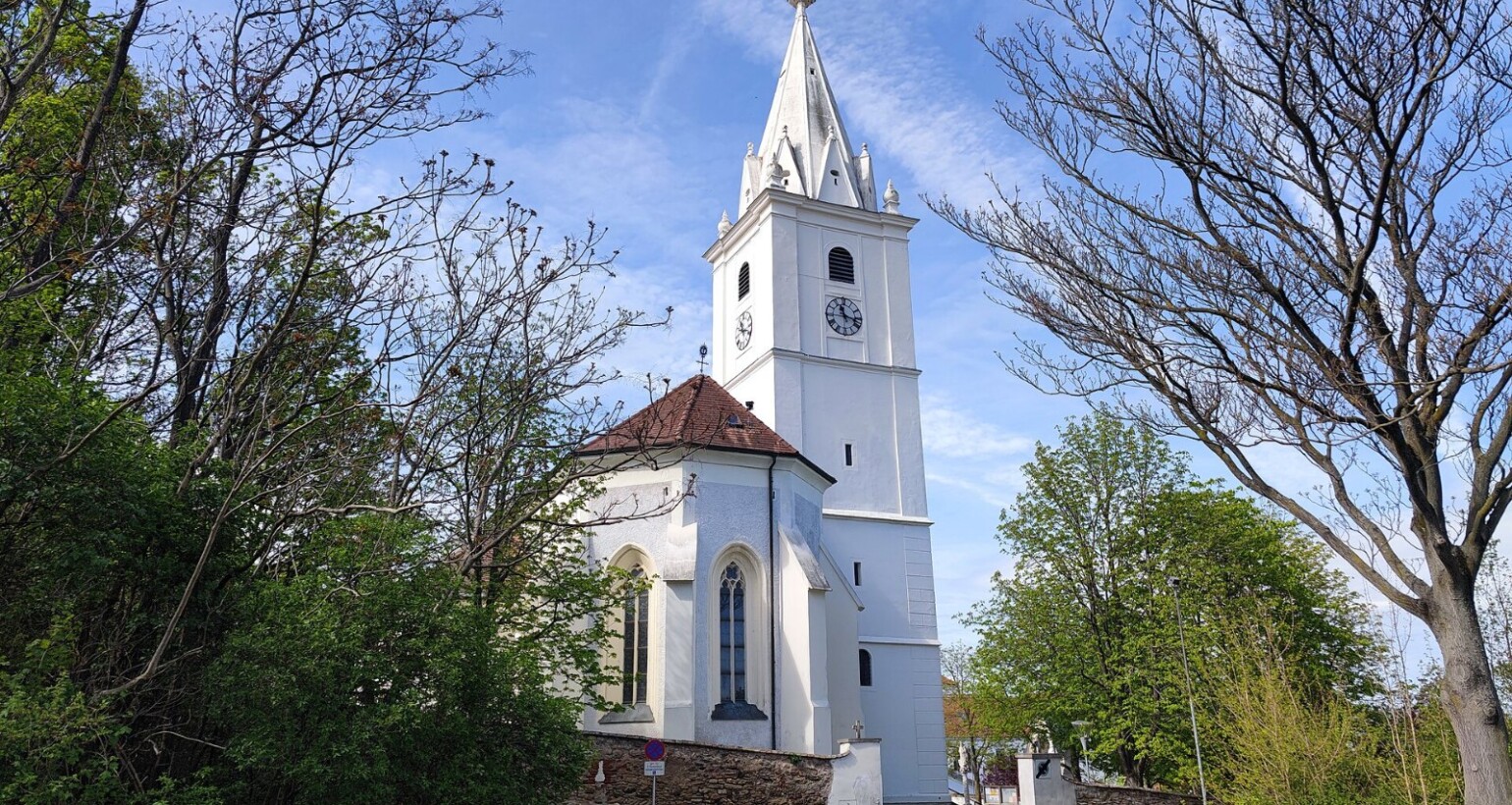
St Martin's parish church in Mattersburg (Nagymarton) gave the small town at the foot of the Rosalia Hills its name and is its oldest building. The Gothic fortified church, standing on a hill above the Wulka valley within a loopholed wall, was built in the 14th–15th centuries and, despite its Baroque alterations, still preserves its late Gothic vaults.
The settlement is mentioned in 1202 as 'villa Martini' in a charter of King Emeric: the village took its name from the patron saint of its church, and the German name Mattersdorf, today Mattersburg, also conceals that of St Martin. The parish is first recorded in 1344 and the church in 1390, while the tower bears the date 1404. The 14th-century tower bay and the Romanesque core of the western walls of the nave suggest that the present church had an earlier predecessor. It was the seat of the counts of Mattersdorf; scholars now believe that the church hill carried not the family's castle but a fortified manor.
The town was ravaged by the Ottomans in 1529 and 1532, and in 1683 the army marching on Vienna burned the church roof; before that, in 1659, the building had already been renewed in Baroque spirit. In the 18th century two aisles were added and a domed oval Baroque chapel was built on the south side. After a lightning strike in 1907 the tower received a new carved stone pyramid spire, and the whole church was restored in 1928 and 1976; on the latter occasion the interior was repainted following traces of the original colours, the late Gothic ribs in ochre with black joints.
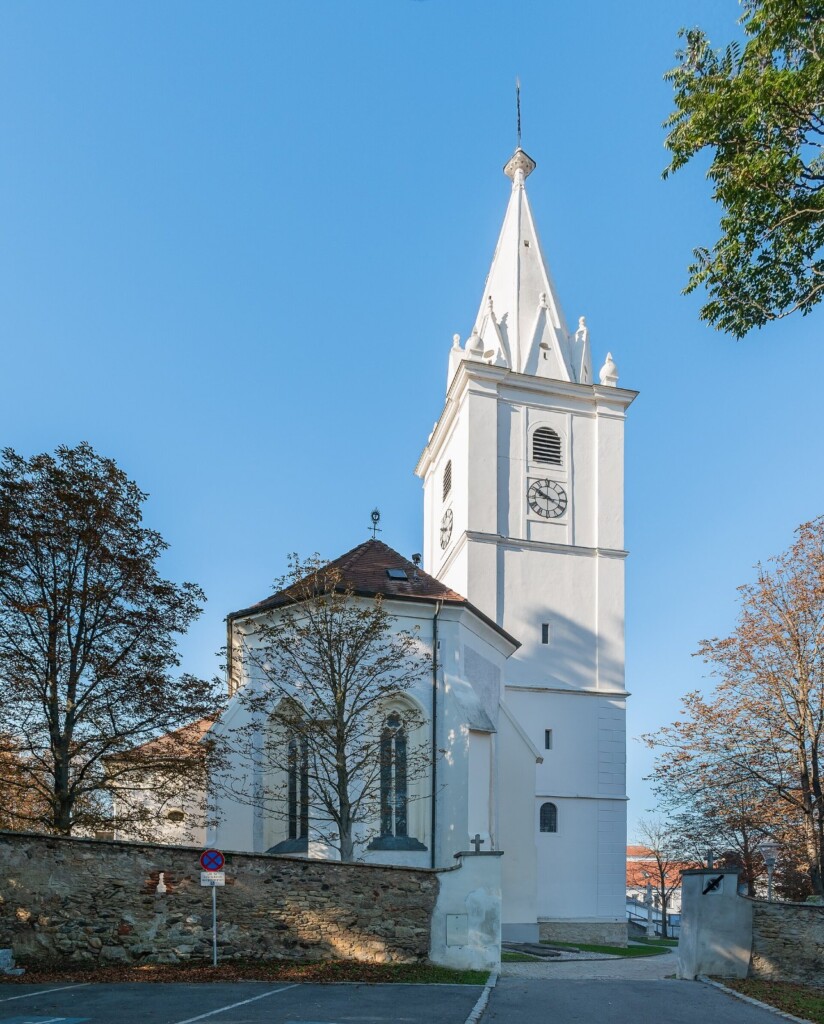
The raised nave of the three-aisled church is covered by a late Gothic net vault, and the long chancel with its five-eighths close has a delicate net vault and a string course, with keyhole loopholes under the eaves. The neo-Gothic high altar of around 1870 carries statues of St Martin, St George and St Dorothy; the Marian altar in the left aisle dates from 1736, and the pulpit of around 1700, with figures of the Saviour, Peter and Paul and the four Evangelists, is the church's finest Baroque piece. The plague altar in the south chapel shows Carolus Aigen's painting of St Sebastian from 1741 with statues of St Francis Xavier and St Joseph; the two choir stalls date from 1774, and one bell was cast by Jacobus Montell of Wiener Neustadt in 1746.
The church hill is still ringed by a loopholed defensive wall, traces of the earthworks raised during the kuruc wars can be seen around it, and a 17th-century stone statue stands before the long church steps. The nearby Rinnsalkapelle is a small 17th-century pilgrimage chapel with an image of the Madonna of Częstochowa.
Pilgrimage feast: the church's titular feast is the day of St Martin of Tours, 11 November.
Visiting: Mattersburg lies 22 km south-west of Eisenstadt and about 20 km from Sopron, on the Wiener Neustadt–Sopron railway; the church stands on a commanding hill in the southern part of the town, reached by the flight of steps known as the Kirchenstiege. The hill offers a fine view of the Wulka valley and the town's famous 250-metre railway viaduct, and nearby Forchtenstein Castle combines well with a visit.
Sources: Wikipedia – Nagymarton (Mattersburg) · Wikipedia (German) – Pfarrkirche Mattersburg
Photo: Helmlechner / Wikimedia Commons, CC0 · Photo: Krzysztof Golik / Wikimedia Commons, CC BY-SA 4.0
Town:
Mattersburg (Nagymarton)