Calvaria Church of Mănăștur – Cluj-Napoca (Kolozsvár)
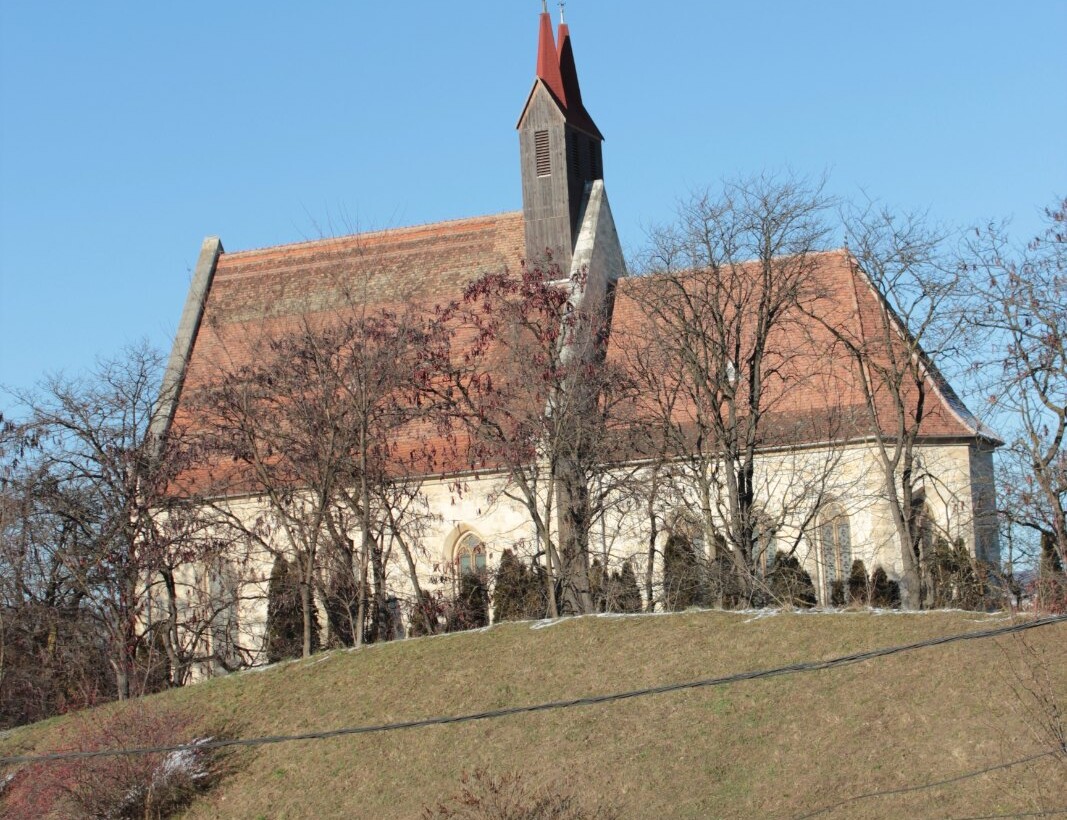
The Calvaria Church in Mănăștur (Kolozsmonostor) is the surviving church of a Benedictine abbey founded in the 11th century – alongside the Diocese of Alba Iulia, one of the earliest and most important institutions of the Catholic Church in Transylvania. Its Gothic chancel is today an outstanding medieval monument of Cluj-Napoca (Kolozsvár).
The monastery, dedicated to the Blessed Virgin Mary, was founded at the earliest under King Béla I and at the latest under King Ladislaus I. It was subject not to the Bishop of Transylvania but directly to the Archbishop of Esztergom, which is why the bishops repeatedly tried to bring it under their control, even by force of arms. The church, destroyed during the Mongol invasion, was rebuilt in the second half of the 13th century. Around 1288 the abbey became a place of authentication (locus credibilis): its registers, kept from 1289 to 1556, are sources of outstanding importance for the history of medieval Transylvania.
The monastery was dissolved in 1556, when church property was secularised, and in 1579 Stephen Báthory granted it to the Jesuits. After the campaigns of the 17th century and a fire in 1704, only the chancel remained intact; from 1818 stones from the ruined nave were carted away to build the Royal Lyceum in Cluj, and in 1819 the chancel was turned into a chapel. The present neo-Gothic nave was built in 1896 by the Transylvanian Roman Catholic Status, and the belfry by the entrance, designed by Károly Kós, dates from 1922.
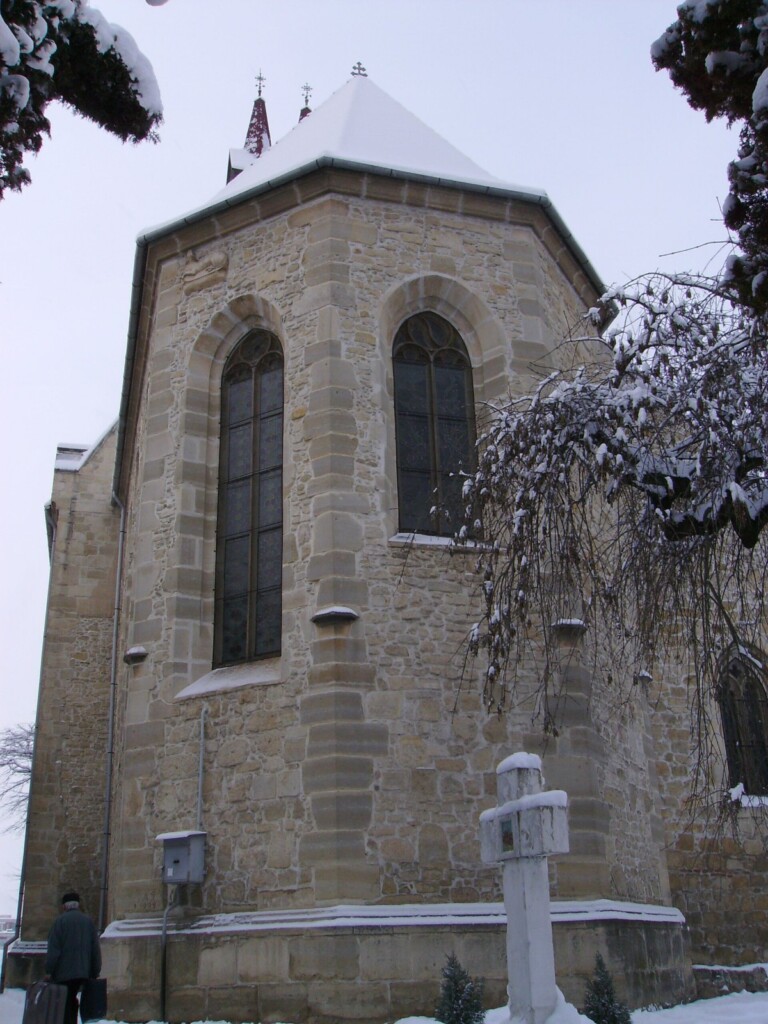
In 1924 the Status lent the church to the Greek Catholics for 25 years, and from 1948 to 1994 it served as an Orthodox church; in 1994 it was returned to the Roman Catholics. Its restoration, carried out without state funding, won a Europa Nostra award, and on 20 June 1997 the renewed church was consecrated in honour of the Assumption by György Jakubinyi, Archbishop of Alba Iulia. On the south wall of the chancel, which ends in three sides of an octagon, are a 15th-century sundial and a Romanesque relief of a lion. The nave holds 14 bronze Stations of the Cross by Jenő Korondi, and the chancel houses an organ built in 1792 for the church of Daia (Szászdálya).
Visiting: the church stands in the western part of Cluj-Napoca, in the Mănăștur district, beside the road to Oradea, on a hill that was once an early medieval earthwork fort, surrounded by blocks of flats. At the entrance stands the Neoclassical Calvary Chapel of 1831, and 14 white stone crosses line the path to the church; on the southern part of the hill are 19th-century tombs, including that of Lieutenant Colonel András Tamás of the Honvéd army, executed in 1849.
Sources: Wikipedia · Wikipedia – Kolozsmonostor · Wikipedia (English)
Photo: Tiberiu Neag / Wikimedia Commons, CC BY-SA 3.0 ro · Photo: Cluj Napoca / Wikimedia Commons, CC BY 2.0
Town:
Cluj-Napoca (Kolozsvár)