Lutheran Fortified Church – Prejmer (Prázsmár)
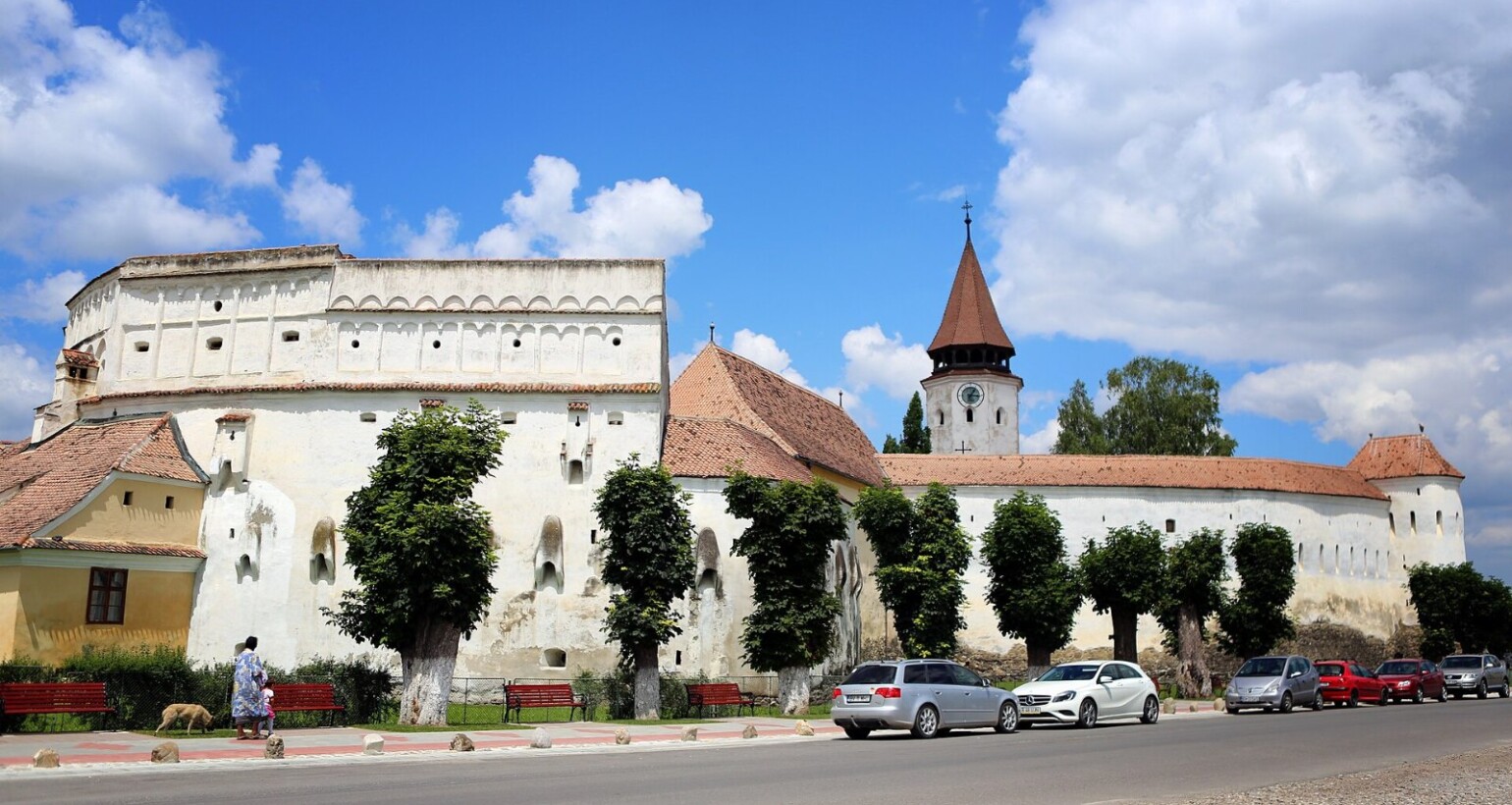
The Lutheran fortified church of Prejmer (Prázsmár) is the most important and best-preserved church fortress of the Burzenland and one of the finest in Transylvania: the Gothic church founded by the Teutonic Knights is enclosed by a ring wall five metres thick and almost twelve metres high, lined on the inside with more than 270 shelter rooms. Since 1999 the complex has been part of the UNESCO World Heritage Site of villages with fortified churches in Transylvania.
King Andrew II of Hungary settled the Teutonic Knights in the Burzenland around 1211; in 1218 the knights began building the church of Prejmer on a Greek-cross plan, unique in Transylvania and more typical of churches in north-eastern Germany. After the order's expulsion in 1225, the Cistercians of Cârța completed the building in the 1240s in their characteristic early Gothic forms. A tower was raised over the crossing in 1461, and between 1512 and 1515 the church was enlarged with two side aisles of unequal size and a lengthened nave. Since the Reformation it has belonged to the Lutheran church of the Transylvanian Saxons.
Prejmer lay in the path of armies breaking through the Buzău Pass: the village was sacked more than fifty times between the 13th and 17th centuries, yet the fortress was rarely taken. The massive walls were built in the 15th century on the orders of Sigismund of Luxembourg, surrounded by a water-filled moat and strengthened by five towers and a battlement walk. The fortress is entered through a 30-metre tunnel defended by portcullises and iron-bound oak gates, with a solid barbican beside it. On the inner side of the walls, four storeys of chambers reached by wooden galleries line the courtyard: each family had one, some 1,600 people could shelter in them during a siege, and in peacetime bacon and grain were stored there – hence the name “bacon chambers”.
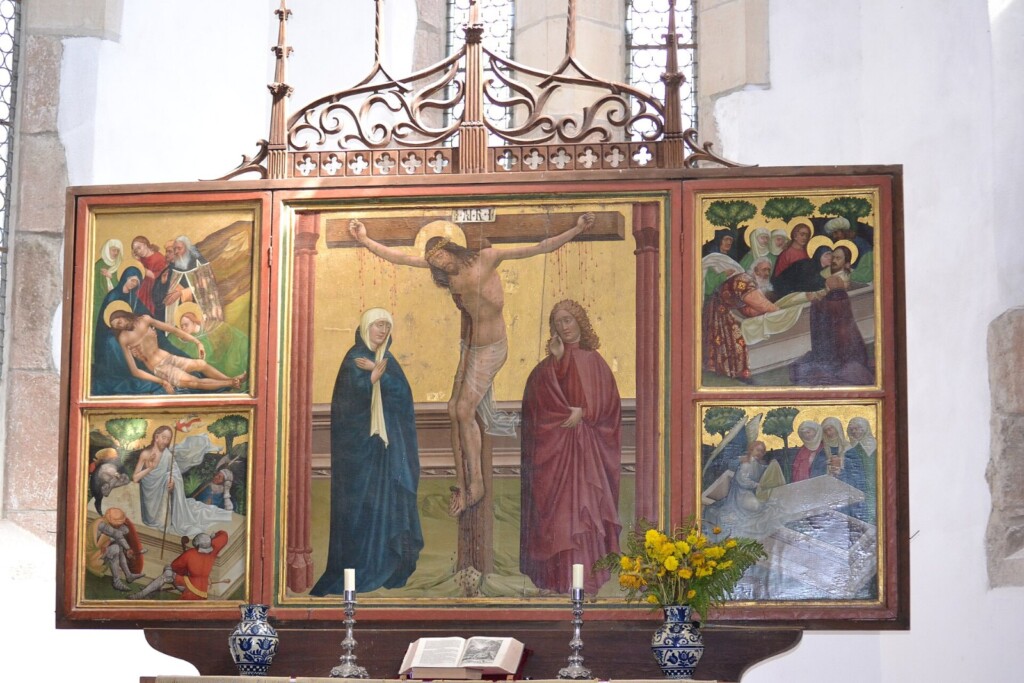
The church's greatest treasure is the winged altarpiece of around 1450, the oldest surviving in Transylvania: an unknown master trained in the Viennese school painted scenes of the Passion, dominated by the central Crucifixion on a gold ground. One of the church bells was cast in 1471. The old school and the bakery, where bread was baked from the flour stored in the fortress, survive in the courtyard wall, and the barbican once housed the town hall. In the early 19th century a colonnaded entrance wing replaced the drawbridge. Since a thorough restoration in the 1960s the fortified church has also served as a museum: some of the chambers, the wall walk and the tower can all be explored.
Visiting: Prejmer lies about 15 kilometres north-east of Brașov on the Burzenland plain and can be reached by car or by local bus from Brașov. The fortified church stands in the centre of the village, entered through the long gate tunnel. The church, the wall chambers and a small local history exhibition are open to ticket-holders; comfortable shoes are advisable for the steep wooden stairs.
Sources: Wikipedia · Wikipedia (English)
Photo: Neighbor’s goat / Wikimedia Commons, CC BY-SA 3.0 ro · Photo: Albuțiu Gabriel Gábor / Wikimedia Commons, CC BY-SA 3.0 ro
Town:
Prejmer (Prázsmár)