Basilica of Our Lady of Loreto – Loretto (Lorettom)
The basilica of Loretto (Lorettom) is Burgenland's foremost Marian shrine, founded in the mid-17th century by the Lord Chief Justice Ferenc Nádasdy on the model of Loreto in Italy. The ensemble of the vast Baroque pilgrimage church, the Loreto chapel in the cloister courtyard and the former Servite monastery draws some two hundred thousand visitors a year and has held the rank of minor basilica since 1997.
The story of the shrine began in 1644, when Rudolf von Stotzingen, feudal tenant of the Hornstein estate, returned from Loreto with a copy of its miraculous statue and built a chapel for it, modelled on the Holy House of Loreto, on the site of a ruined chapel of St John of 1431. From 1648 the Servites of Stotzing said Mass there. Ferenc Nádasdy, who acquired the estate in 1650, laid the foundation stone of a new, large church and monastery in 1651; its architect was probably Antonio Riebler. The church was consecrated on 2 July 1659 in the presence of the Hungarian prelates and high nobility and some twenty thousand pilgrims, and the chapel was moved to its present place in the cloister courtyard at the same time.
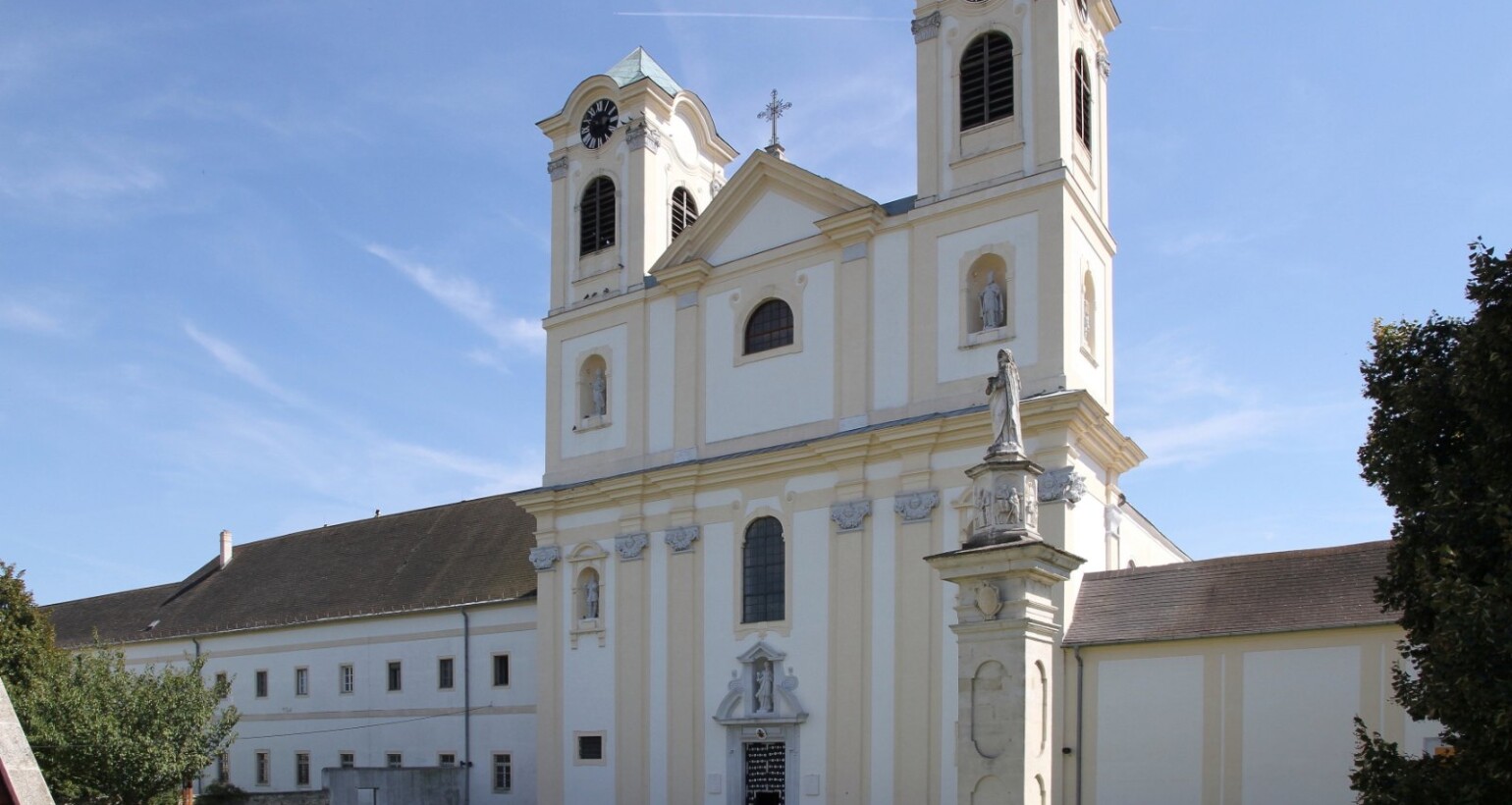
On 13 July 1683 the Ottoman army marching on Vienna set fire to the church and monastery; the statue had been taken to safety in Forchtenstein Castle in time. The rebuilding is linked to Prince Paul Esterházy; the church was reconsecrated in 1707, and the pilgrimages soon gained new momentum: in 1746 Maria Theresa herself came here. In 1738–1740 a twin-towered façade was built, but its onion domes burned in 1781 and low pyramid roofs have covered the towers ever since. Joseph II dissolved the monastery in 1787 and banned the pilgrimage; the building served as a military hospital and then as the wool depot of the Esterházy estate. The Servites returned between 1926 and 1956, and since 1964 the shrine has been in the care of the Oblates of the Virgin Mary.
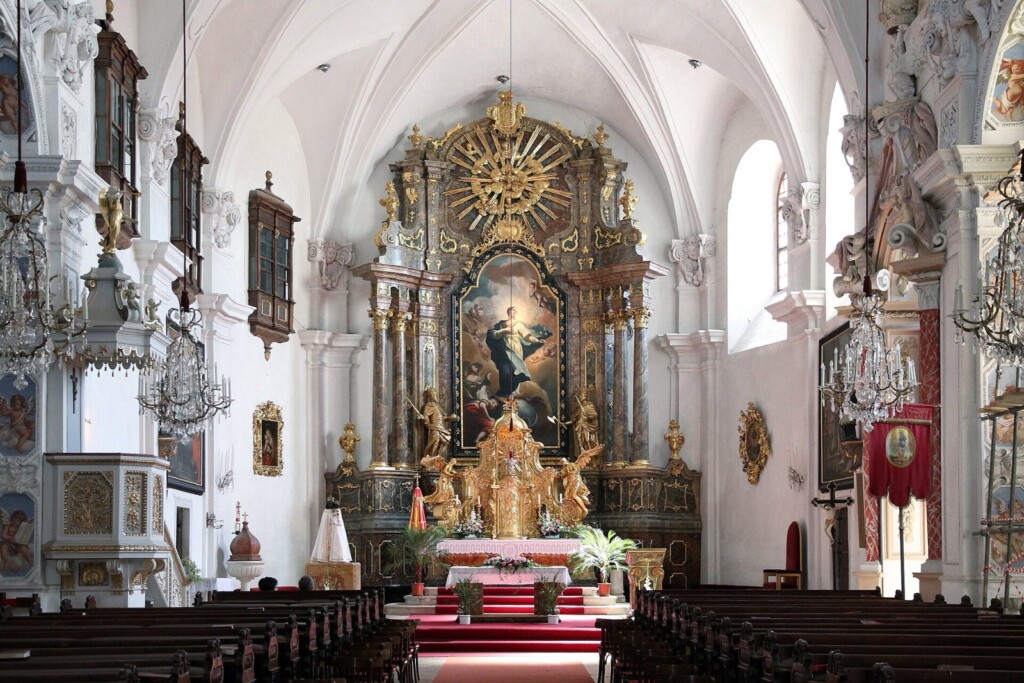
The barrel-vaulted church of four bays opens on both sides onto chapels founded in the 17th–18th centuries by aristocratic families – the Draskovichs, Nádasdys and Bucellinis. The stucco of the lower nave dates from around 1650–1670 and is attributed to Carlo Martino Carlone. The high altar was donated in 1766 by the cavalry colonel János Lipthay and bears the arms of Paul Esterházy, donor of the first high altar; the organ of 1761 is by Johann Rath of Sopron. Statues of the holy kings Stephen and Ladislaus stand in niches of the façade. In the rear room of the Loreto chapel in the cloister courtyard, the 'black kitchen', the Black Madonna of 1644 is kept with a silver crown made in 1715. In 2016 a statue of the Virgin mutilated in 1683 was found beneath the stone slab of the chapel altar and restored by the federal heritage office.
Pilgrimage feast: the basilica is dedicated to the Immaculate Conception (8 December); the great feast and fair is held on the Assumption, 15 August, and a monthly pilgrimage takes place on the 8th of every month.
Visiting: Loretto lies about 13 km from Eisenstadt and 38 km from Vienna, at the north-western foot of the Leitha Hills, immediately next to Stotzing. The basilica rises at the end of the village's spacious green, adorned with Baroque columns; in front of it a Marian column of around 1700 marks the original site of the chapel. The shrine is also a popular wedding venue, so ceremonies can be expected at weekends.
Sources: Wikipedia – Lorettom (Loretto) · Wikipedia (German) – Basilika Maria Loretto im Burgenland · Wikipedia (German) – Loretto (Burgenland)
Photo: C.Stadler/Bwag / Wikimedia Commons, CC BY-SA 3.0 at · Photo: C.Stadler/Bwag / Wikimedia Commons, CC BY-SA 3.0 at
Town:
Loretto (Lorettom)