Church of the Nativity of Mary – Racu (Csíkrákos)
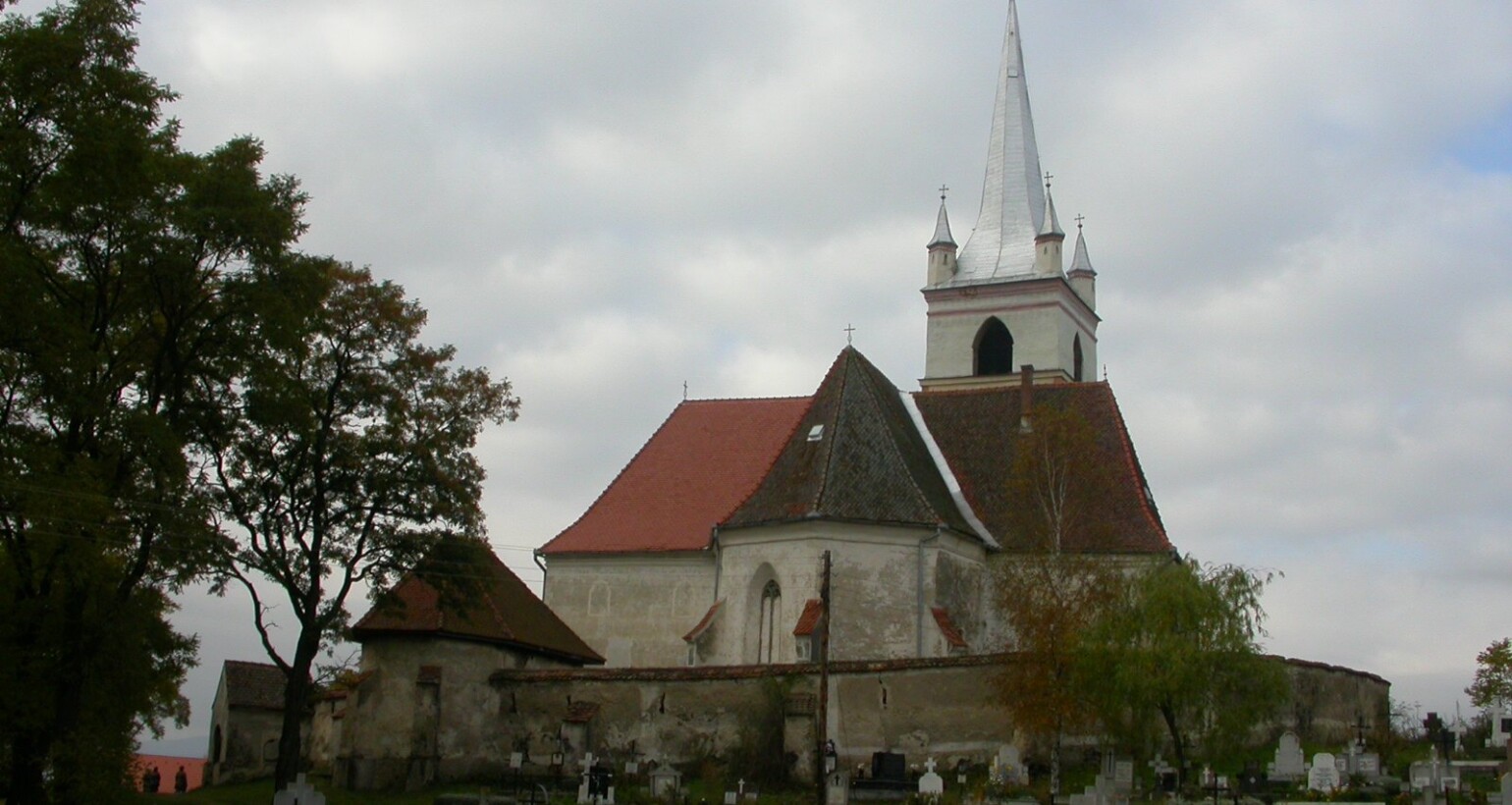
The Church of the Nativity of Mary in Racu (Csíkrákos) is one of the oldest fortified churches of the Ciuc (Csík) region, of Árpád-era origin and still surrounded by a loopholed defensive wall. Its best-known feature is the rough-stone tower, whose walls are covered with red-painted animals, human figures and heavenly bodies – mostly the signs of the zodiac.
The church stands on a rise above the Rákos stream, in the part of the village known as Göröcsfalva. On the evidence of old parish records and of its Romanesque details – the round-arched stone frame of the south door and the stone-columned porch – it was probably built around 1270–1280; the village itself is first mentioned in writing in 1334. The tower and the polygonal chancel were added in the second half of the 15th century in late Gothic style; the corbels of the vault bear the arms of the Hont-Pázmány clan and the raven of the Hunyadi family. In the 19th century Balázs Orbán ranked it first among the churches of Ciuc.
The defensive walls were built in the 17th century, yet the Tatar raid of 1661 still caused heavy damage, and only fragments of the nave's painted ceiling survived. Between 1756 and 1758 the church was remodelled in Baroque spirit: transepts were added, the tower was raised, and a bell chamber with pointed windows and an arcaded south corridor were built. During the restoration of 1938 two medieval fresco fragments came to light in the chancel. Buried in the churchyard is the parish priest Péter Zöld, a leader of the Székely resistance of 1762; the nearby field of Rákosmezeje was an ancient assembly place of the Székelys, where the protesters gathered in 1764, shortly before the massacre of Madéfalva.
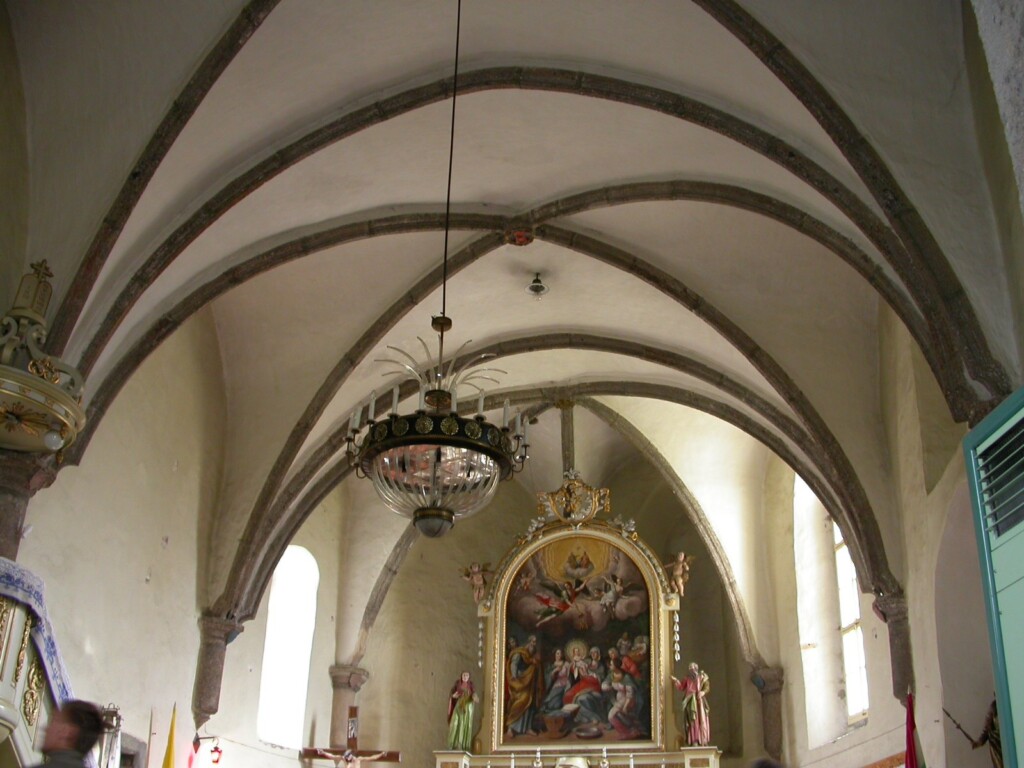
The 30-metre tower has Árpád-era foundations, five medieval storeys and an 18th-century bell chamber with a pointed-arch design; its tin spire is flanked by four turrets. Narrow loopholes open on each storey, and the figures painted in square fields date from the Gothic period. Inside, a pointed chancel arch divides the space: the nave, nearly 10 metres long, has a flat ceiling, while the 16-metre chancel is covered by a Gothic net vault whose keystone shows the Sun and the Moon. The high altarpiece, the Birth of the Virgin, was painted by Mátyás Veres in 1794, and the altar was donated by Mihály Burján, canon of Alba Iulia. By the south wall stands a late 17th-century altar of St Joseph, the Stations of the Cross were painted by Kristóf Rómer, a captain of the Székely border guard, and two archaic stone holy-water stoups and the font are also among the church's treasures. The irregular defensive wall, 2.5–3 metres high, has a Baroque gabled gateway on its south side.
Pilgrimage feast: the church celebrates its feast on 8 September, the Nativity of the Blessed Virgin Mary.
Visiting: Racu lies some 10 km north of Miercurea Ciuc (Csíkszereda) on the DN12 main road; the fortified church stands slightly off the road in the Göröcsfalva quarter, on the hill beside the cemetery. Enquire at the parish office about seeing the interior. The Cserei manor in the village, the chapel on Bogát hill and the ruins of Pogányvár in the surrounding hills are also worth a detour.
Sources: Wikipedia – Fortified Roman Catholic church of Csíkrákos · Wikipedia – Csíkrákos (Racu) · Wikipedia – Fortified churches of Székely Land
Photo: Andrei kokelburg / Wikimedia Commons, CC BY-SA 3.0 ro · Photo: Andrei kokelburg / Wikimedia Commons, CC BY-SA 3.0 ro
Town:
Racu (Csíkrákos)